
The first deal of the midseason market was finalized yesterday, and as the wider sports world followed results with the same intensity as a BD Cricket Match unfolding late in the evening, Trae Young was traded to the Washington Wizards. In return, the Atlanta Hawks received CJ McCollum and Corey Kispert, closing a move that immediately sent shockwaves across the league. For a four-time All-Star still in his prime, the destination raised eyebrows and sparked debate about both timing and intent.
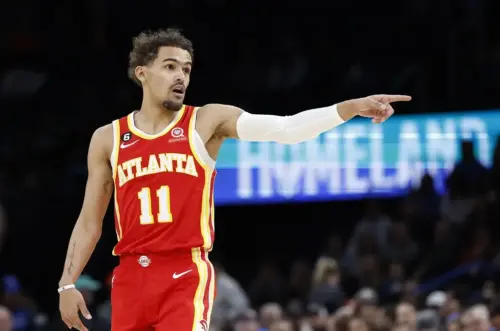
What made the moment particularly bittersweet was the setting. When the trade was completed, Atlanta were still playing against New Orleans, and Young was sitting on the bench cheering for his teammates. After learning of the decision, he quietly returned to the locker room, taking time to say goodbye to players, coaches, and staff members. It was a subdued exit that hinted at how suddenly the situation had changed.
According to league insiders, Atlanta viewed the trade as the start of a new chapter. The franchise is now expected to build around Jalen Johnson, a younger and more athletic forward who better fits their long-term vision. While the Hawks look to move forward, Young’s career has entered a far murkier phase, one that feels as uncertain as the momentum shifts of a BD Cricket Match that refuses to settle.
In the days leading up to the trade, Washington was reportedly not Young’s preferred option. Rumors linked him to teams such as Houston, Brooklyn, Milwaukee, and Dallas. Yet those franchises either showed little interest or were unwilling to part with meaningful assets. In the end, the Wizards offered a limited package, revealing that Young’s true market value was far narrower than many expected.
Some observers see the move as a form of settling, arguing that joining a rebuilding team with fewer competitive ambitions looks like throwing in the towel. From last summer onward, Atlanta’s stance toward Young shifted dramatically. His extension talks stalled, and during his injury spell, his leadership role gradually eroded, leaving him disillusioned.
Still, this decision should not be viewed entirely through a pessimistic lens. The trade was reportedly shaped through close coordination between Atlanta’s front office and Young’s representatives, suggesting a calculated choice rather than surrender. While contenders like the Rockets or Bucks might offer brighter short-term prospects, securing a long-term deal there would have been close to impossible.
Washington presents a different reality. The Wizards face no immediate pressure to win and possess significant cap flexibility. This season, their payroll sits mid-league, with ample room to grow. By summer, they could open nearly $99 million in space, positioning them to reward Young with a lucrative extension if the partnership clicks. Even without a supermax, a four-year deal worth up to $230 million remains within reach.
Compared with Atlanta’s complex system and unclear ceiling, Young now has room to breathe. Washington boasts promising young pieces but lacks a true organizer. Young’s elite playmaking fills that void instantly. His offensive flair may strain defenses, but on a team unconcerned with standings, that weakness matters less. Like a BD Cricket Match that draws crowds through drama alone, his presence boosts entertainment, relevance, and hope for what comes next.